A universal IR with per-opcode typed instructions, 15 deterministic frontends, LLM-assisted repair/lowering/execution, a deterministic VM with class hierarchy support, overload resolution, and cross-language slicing, a structured type system with generics/unions/variance/traits and interface-aware inference, and iterative dataflow analysis.
GitHub: avishek-sen-gupta/red-dragon
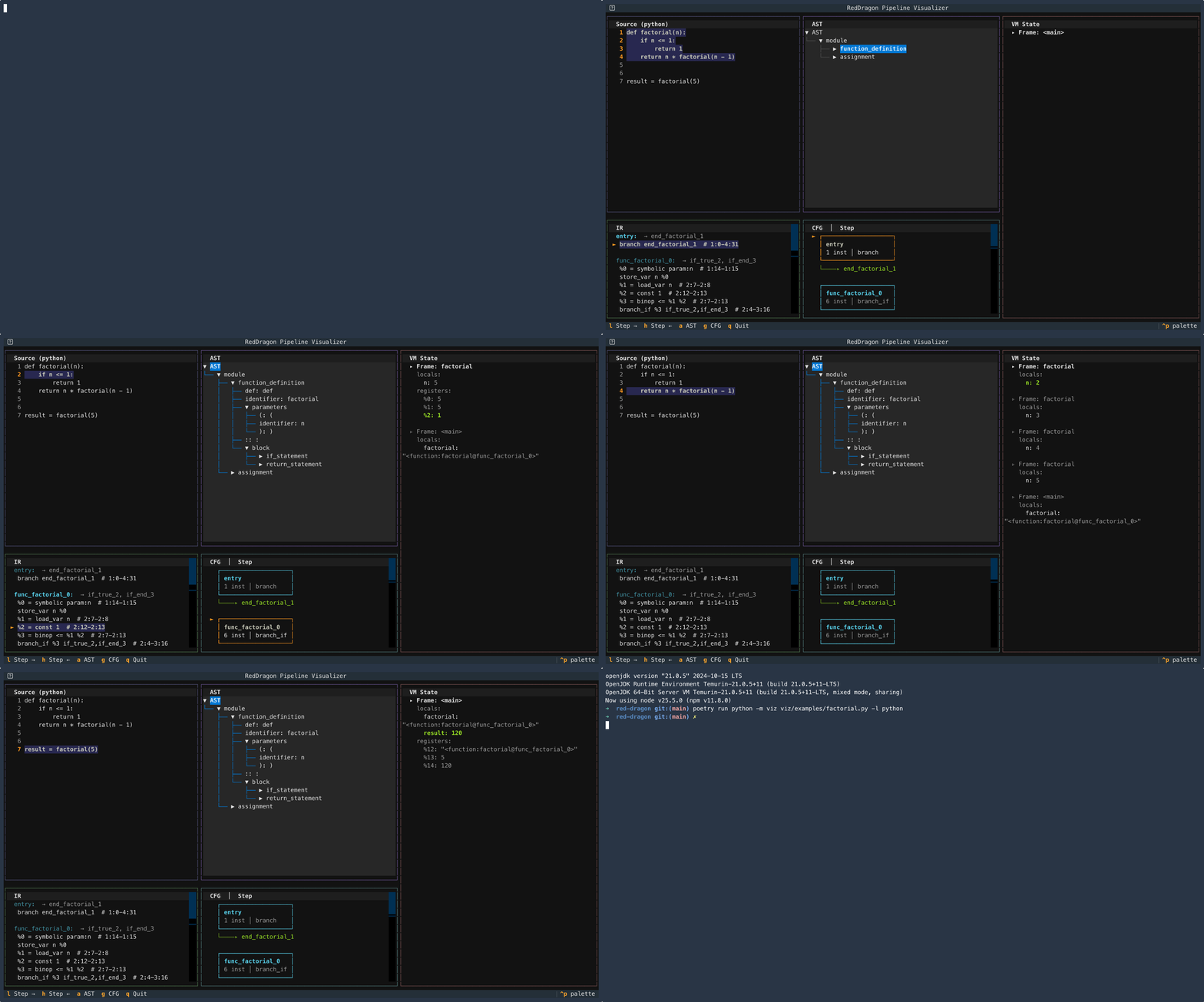
The Problem
I wanted to analyse source code across many languages (trace data flow, build control flow graphs, understand how variables depend on each other) without writing a separate analyser for each language. The conventional approach is to build language-specific tooling (Roslyn for C#, javac’s AST for Java, etc.), but that means duplicating every downstream analysis pass for every language. I wanted one representation, one analyser, many languages.
Established IRs exist for this kind of work. LLVM IR covers C, C++, Rust, Swift, and others. WebAssembly targets a growing set of languages. GraalVM’s Truffle framework provides a polyglot execution layer. I considered all of these and chose to build my own for three reasons:
- No single existing IR covered the full set of languages I wanted to analyse (Python, Ruby, JavaScript, TypeScript, PHP, Lua, Scala, Kotlin, Go, Java, C#, C, C++, Rust, Pascal, and COBOL).
- Existing IRs assume programs are complete and all dependencies are resolved. They are not designed for incomplete code with missing imports, unresolved externals, or partial extracts.
- I wanted to integrate LLM-based lowering and LLM-assisted execution as first-class features of the pipeline, and grafting that onto an existing IR’s toolchain would have taken more time than building a purpose-built one.
The twist: I wanted to handle incomplete programs gracefully. Real-world code depends on imports, frameworks, and external systems that aren’t available during static analysis. Most tools crash or give up when they hit an unresolved reference. I wanted mine to keep going, creating symbolic placeholders for unknowns and tracing data flow through them.
RedDragon is the result. It parses source in 15 languages, lowers it to a universal intermediate representation, builds control flow graphs, performs iterative dataflow analysis, and executes programs via a deterministic virtual machine. All with zero LLM calls for programs with concrete inputs. RedDragon is a work in progress.
This post covers how the system is designed: the IR, the frontends, the VM, type inference, and the dataflow analysis.
Motivation
RedDragon is the natural extension of my earlier work on Cobol-REKT, a COBOL reverse engineering toolkit. That project taught me the value of building analysis tools for legacy code, and left me wanting to generalise the approach across languages. I’d also built a small VM in Prolog previously, and wanted to attempt a more complete one — with a proper type system, dataflow analysis, and multi-language support.
Beyond the technical goals, this project was also a deliberate exercise in AI-assisted software development. I wanted to actively practise and improve my skills in directing an AI to build non-trivial systems — understanding where it works well, where it doesn’t, and how to structure the collaboration. The companion post covers that side of the experience.
RedDragon is a work in progress, and this post is a snapshot of where it stands today. My understanding of compiler design, type systems, and program analysis continues to evolve alongside the project.
Core Theses
RedDragon explores three ideas about analysing frequently-incomplete code, the kind found in legacy migrations, decompiled binaries, partial extracts, and codebases with missing dependencies:
-
Deterministic language frontends with LLM-assisted repair. Tree-sitter frontends (15 languages) and a ProLeap bridge (COBOL) handle well-formed source deterministically. When tree-sitter hits malformed syntax, an optional LLM repair loop fixes only the broken fragments and re-parses, maximising deterministic coverage for real-world incomplete code. All paths produce the same universal IR.
-
Full LLM frontends for unsupported languages. For languages without a tree-sitter frontend, an LLM lowers source to IR entirely, supporting any language without new parser code. A chunked variant splits large files into per-function chunks via tree-sitter, lowering each independently. The LLM acts as a compiler frontend, constrained by a formal IR schema with concrete patterns. It’s translating syntax, not reasoning about semantics.
-
A VM that integrates LLMs only at the boundaries where information is genuinely missing. When execution hits missing dependencies, unresolved imports, or unknown externals, a configurable resolver can invoke an LLM to produce plausible state changes, keeping execution moving through incomplete programs instead of halting at the first unknown. When source is complete and all dependencies are present, the entire pipeline (parse → lower → execute) is deterministic with zero LLM calls.
Table of Contents
- Architecture Overview
- A Worked Example: Source to Execution
- The IR: 33 Opcodes to Rule Them All
- Frontends: Four Strategies, One Output
- LLM-Assisted AST Repair
- LLM Frontend: Lowering Unknown Languages
- The Dispatch Table Engine
- Lowering Equivalence
- The Deterministic VM
- LLM-Assisted VM Execution
- Dataflow Analysis
- Type Inference
- Cross-Language Type Inference in Practice
- Cross-Language Verification via Exercism
- References
Architecture Overview
RedDragon follows a classic compiler pipeline:
%%{ init: { "flowchart": { "curve": "stepBefore" } } }%%
flowchart TD
    src("📄 Source Code<br/><i>15 languages</i>"):::input
    frontend("🔧 Frontend<br/><i>deterministic or LLM-based</i>"):::transform
    cfg("🔀 CFG Builder"):::analysis
    typeinf("🏷️ Type Inference"):::analysis
    vm("⚙️ VM"):::engine
    dataflow("📊 Dataflow Analysis"):::engine

    src --> frontend
    frontend -->|"list[TypedInstruction]"| cfg
    frontend -->|"list[TypedInstruction]"| typeinf
    typeinf -->|"TypeEnvironment"| vm
    cfg --> vm
    cfg --> dataflow

    classDef input fill:#e8f4fd,stroke:#4a90d9,stroke-width:2px,color:#1a3a5c
    classDef transform fill:#fff3e0,stroke:#e8a735,stroke-width:2px,color:#5c3a0a
    classDef analysis fill:#f3e5f5,stroke:#7b1fa2,stroke-width:2px,color:#3a0a3a
    classDef engine fill:#e8f5e9,stroke:#2e7d32,stroke-width:2px,color:#1a3a1a
Every stage operates on the same flat IR. The type inference pass, VM, and dataflow analysis are all language-agnostic. They don’t know whether the instructions came from Python, Rust, or COBOL.
A Worked Example: Source to Execution
To make the pipeline concrete, here’s a complete trace of a simple program through every stage. This is the same pipeline that runs for all 15 languages.
Source (Python)
def classify(x):
    if x > 0:
        label = "positive"
    else:
        label = "negative"
    return label

result = classify(5)
Stage 1: Lowering to IR
The Python tree-sitter frontend parses this and emits flat three-address code. The function body is wrapped in a skip-over pattern (a BRANCH jumps past it so it’s not executed at definition time):
branch end_classify_0                    # skip over body
func_classify_0:                         # entry point
  %0 = symbolic param:x                  # parameter binding
  decl_var x %0
  %1 = load_var x                        # if x > 0
  %2 = const 0
  %3 = binop > %1 %2
  branch_if %3 if_true_0,if_false_0
if_true_0:
  %4 = const "positive"
  decl_var label %4
  branch if_end_0
if_false_0:
  %5 = const "negative"
  store_var label %5                     # assignment to existing var
  branch if_end_0
if_end_0:
  %6 = load_var label
  return %6
end_classify_0:
  %7 = const <function:classify@func_classify_0>
  decl_var classify %7
  %8 = const 5
  decl_var x %8
  %9 = call_function classify %8         # classify(5)
  decl_var result %9
Every instruction is a flat dataclass with an opcode, operands, a destination register, and a source location tracing it back to the original line and column. No nested expressions. x > 0 decomposes into LOAD_VAR, CONST, BINOP.
Stage 2: CFG Construction
The CFG builder splits the IR at every LABEL and after every BRANCH/BRANCH_IF/RETURN/THROW, then wires edges based on branch targets:
flowchart TD
entry(["<b>entry</b><br/>BRANCH end_classify_0"]):::entry
func("<b>func_classify_0</b><br/>SYMBOLIC param:x · DECL_VAR x<br/>LOAD x · CONST 0 · BINOP ><br/>BRANCH_IF"):::block
if_true("<b>if_true_0</b><br/>CONST "positive"<br/>DECL_VAR label · BRANCH"):::branch
if_false("<b>if_false_0</b><br/>CONST "negative"<br/>STORE_VAR label · BRANCH"):::branch
if_end(["<b>if_end_0</b><br/>LOAD label<br/>RETURN"]):::exit
end_classify("<b>end_classify_0</b><br/>CONST function · DECL_VAR classify<br/>CONST 5 · DECL_VAR x<br/>CALL classify · DECL_VAR result"):::block
entry --> end_classify
entry -.->|"skip"| func
func -- "T" --> if_true
func -- "F" --> if_false
if_true --> if_end
if_false --> if_end
end_classify -.->|"call"| func
classDef entry fill:#e8f4fd,stroke:#4a90d9,stroke-width:2px,color:#1a3a5c
classDef block fill:#fff3e0,stroke:#e8a735,stroke-width:2px,color:#5c3a0a
classDef branch fill:#f3e5f5,stroke:#7b1fa2,stroke-width:2px,color:#3a0a3a
classDef exit fill:#e8f5e9,stroke:#2e7d32,stroke-width:2px,color:#1a3a1a
Stage 3: VM Execution (0 LLM calls)
The deterministic VM executes step by step. When it hits CALL_FUNCTION classify, it pushes a new stack frame, binds the parameter x = 5, and jumps to func_classify_0:
step  1: branch end_classify_0          → skip to end_classify_0
step  2: const <function:classify>       → %7 = <function:classify@func_classify_0>
step  3: decl_var classify %7            → classify = <function>
step  4: const 5                         → %8 = 5
step  5: decl_var x %8                   → x = 5
step  6: call_function classify %8       → push frame, jump to func_classify_0
step  7: symbolic param:x               → %0 = 5 (bound from caller)
step  8: decl_var x %0                   → x = 5
step  9: load_var x                      → %1 = 5
step 10: const 0                         → %2 = 0
step 11: binop > %1 %2                   → %3 = True (5 > 0)
step 12: branch_if %3 if_true,if_false   → True, jump to if_true_0
step 13: const "positive"                → %4 = "positive"
step 14: decl_var label %4               → label = "positive"
step 15: branch if_end_0                 → jump to if_end_0
step 16: load_var label                  → %6 = "positive"
step 17: return %6                       → pop frame, return "positive"
step 18: decl_var result %9              → result = "positive"

Final state: result = "positive"  (18 steps, 0 LLM calls)
Stage 4: Dataflow Analysis
The reaching definitions analysis traces through the register chain. The raw def-use chain says “result depends on %9”. But tracing through: %9 comes from CALL_FUNCTION on classify with argument %8; inside the call, label is set to "positive" (the branch taken); label is loaded into %6 and returned. The dependency graph says: result depends on classify and x.
The LLM-Assisted VM Execution section shows what happens when the source has missing dependencies: the VM creates symbolic placeholders that propagate deterministically, preserving dataflow tracing even without concrete values.
The IR: 33 Opcodes to Rule Them All
See also: IR Reference
The intermediate representation is a flattened three-address code with 33 opcodes, grouped by role:
Value producers:   CONST, LOAD_VAR, LOAD_FIELD, LOAD_INDEX,
                   NEW_OBJECT, NEW_ARRAY, BINOP, UNOP,
                   CALL_FUNCTION, CALL_METHOD, CALL_UNKNOWN,
                   CALL_CTOR

Value consumers:   STORE_VAR, STORE_FIELD, STORE_INDEX, DECL_VAR

Control flow:      BRANCH, BRANCH_IF, LABEL, RETURN, THROW,
                   TRY_PUSH, TRY_POP

Pointers:          ADDRESS_OF, LOAD_INDIRECT, LOAD_FIELD_INDIRECT,
                   STORE_INDIRECT

Regions:           ALLOC_REGION, WRITE_REGION, LOAD_REGION

Continuations:     SET_CONTINUATION, RESUME_CONTINUATION

Escape hatch:      SYMBOLIC
DECL_VAR is a recent addition that separates variable declarations from assignments. Previously, STORE_VAR handled both, always writing to the current stack frame. This meant assignments inside nested functions could never modify outer-scope variables — a fundamental scope chain bug. DECL_VAR writes only to the current frame (for let x = ..., var x = ...), while STORE_VAR now walks the scope chain to find existing bindings. All 15 frontends emit DECL_VAR for declarations and STORE_VAR for assignments.
The first 21 opcodes handle all general-purpose lowering across 15 languages. TRY_PUSH and TRY_POP model structured exception handling (pushing/popping handler labels onto the VM’s exception stack). ADDRESS_OF supports pointer aliasing: &x on a primitive promotes the variable to a heap object and returns a typed Pointer(base, offset), enabling *ptr = 99 to update the original variable through the alias (see Pointer Aliasing). The three region opcodes (ALLOC_REGION, WRITE_REGION, LOAD_REGION) provide byte-addressed memory for COBOL-style overlays, REDEFINES, and packed data layouts. The two continuation opcodes (SET_CONTINUATION, RESUME_CONTINUATION) model COBOL’s PERFORM return semantics, where control transfers to a named paragraph and returns to the caller on completion. The extended opcodes are language-agnostic in the IR and VM; they happen to be emitted by specific frontends but could serve broader use cases.
Every instruction is a frozen dataclass with named fields: an opcode, typed operands (registers as Register objects, labels as CodeLabel objects, operators as BinopKind/UnopKind enums), a destination register, and a source location tracing it back to the original code. Each opcode has its own dataclass (e.g., Binop, LoadVar, CallFunction) rather than a generic container with positional operands. No nested expressions. a + b * c decomposes into:
%0 = const b
%1 = const c
%2 = binop * %0 %1
%3 = const a
%4 = binop + %3 %2
This verbosity is the trade-off for universality. CFG construction, dataflow analysis, and VM execution all operate on the same flat list. Adding a new language means emitting these opcodes; everything downstream works automatically.
Source Location Traceability
Every instruction carries a SourceLocation with start/end line and column, captured from the tree-sitter AST node that generated it. The IR’s string representation appends this:
%0 = const 10 # 1:4-1:6
This means any IR instruction, any VM execution step, any dataflow dependency can be traced back to the exact span of source code that produced it. When a symbolic value appears in the output, its provenance chain leads back to specific source lines.
Control Flow and Functions
All control flow is explicit: labels, conditional branches, and unconditional jumps. There are no structured if/while/for constructs. BRANCH_IF carries its branch targets as a typed branch_targets: tuple[CodeLabel, ...] field. The CFG builder splits the IR into basic blocks at every LABEL and after every BRANCH/BRANCH_IF/RETURN/THROW, then wires edges based on the branch targets. Loops become back-edges: a while loop’s BRANCH at the end of the body points back to the condition’s label. Function definitions use the skip-over pattern shown in the worked example: a BRANCH jumps past the body at definition time, and a FunctionRegistry scans the IR for SYMBOLIC "param:" markers to extract parameter names, map class names to method labels, and build linearized parent chains for class inheritance (see Class Hierarchy and Inherited Method Dispatch).
Four Call Variants
The IR distinguishes four kinds of calls:
CALL_FUNCTION: static calls where the target is a known name. Fields:func_name,args.CALL_METHOD: method calls on objects. Fields:obj_reg,method_name,args.CALL_UNKNOWN: dynamic calls where the target is a computed expression (a variable holding a function reference, or a closure). Fields:target_reg,args.CALL_CTOR: explicit constructor calls, separatingnew ClassName(args)from regular function calls. Fields:class_name,args. This avoids the need for runtime heuristics to distinguish constructor calls from function calls, and gives the VM a clean dispatch path for object allocation + initialisation.
The frontend decides which to emit based on the AST: foo(x) emits CALL_FUNCTION, obj.foo(x) emits CALL_METHOD, some_var(x) where some_var isn’t a known function emits CALL_UNKNOWN, and new Foo(x) emits CALL_CTOR.
Object and Array Construction
Objects and arrays are created via NEW_OBJECT/NEW_ARRAY followed by STORE_FIELD/STORE_INDEX for each member. An array literal [1, 2, 3] lowers to:
%0 = const 3
%1 = new_array list %0
%2 = const 0
%3 = const 1
store_index %1 %2 %3         # array[0] = 1
%4 = const 1
%5 = const 2
store_index %1 %4 %5         # array[1] = 2
%6 = const 2
%7 = const 3
store_index %1 %6 %7         # array[2] = 3
This verbose expansion means the VM and dataflow analysis see every individual element assignment, which matters for tracking which values flow into which positions.
The SYMBOLIC Escape Hatch
SYMBOLIC is the escape hatch. When a frontend encounters a construct it doesn’t handle, it emits SYMBOLIC "unsupported:list_comprehension" instead of crashing. The VM treats it as a symbolic value that propagates through execution. Parameters use it too (SYMBOLIC "param:x"), as do caught exceptions (SYMBOLIC "caught_exception:ValueError").
Over time, unsupported: emissions get replaced with real IR as frontends gain coverage. The project’s history is essentially the story of systematically eliminating every last SYMBOLIC.
Frontends: Four Strategies, One Output
See also: Frontend Design · Per-Language Frontend Docs
All four frontend strategies produce the same list of typed instructions. They differ in speed, coverage, and determinism:
1. Deterministic frontends (15 languages): Python, JavaScript, TypeScript, Java, Ruby, Go, PHP, C#, C, C++, Rust, Kotlin, Scala, Lua, Pascal. These use tree-sitter for parsing and a dispatch-table-based recursive descent for lowering. Sub-millisecond. Zero LLM calls. Fully testable. Each frontend is modularised into separate files for expressions, control flow, and declarations, inheriting from a shared BaseFrontend. An optional AST repair decorator can wrap any deterministic frontend to handle malformed source (see the next section).
2. COBOL frontend (ProLeap bridge): COBOL source is parsed by the ProLeap COBOL parser (a Java-based parser producing an Abstract Syntax Graph), bridged to Python via a shaded JAR that emits JSON ASGs. The frontend includes a complete type system: PIC clause parsing (zoned decimal, COMP/COMP-1/COMP-2, packed decimal, alphanumeric, EBCDIC), REDEFINES overlays with byte-addressed memory regions, OCCURS arrays with subscript resolution, level-88 condition names with value ranges, and paragraph-based control flow via named continuations. COBOL-specific IR is emitted using the region and continuation opcodes.
3. LLM frontend: For languages without a deterministic frontend. The source is sent to an LLM constrained by a formal schema: all 33 opcode specs, concrete patterns, and worked examples. The LLM acts as a mechanical compiler frontend, not a reasoning engine. This distinction matters: the prompt doesn’t ask “what does this code do?” It asks “translate this into these specific opcodes.”
4. Chunked LLM frontend: For large files that overflow context windows. Tree-sitter decomposes the file into per-function chunks, each is LLM-lowered independently, registers and labels are renumbered to avoid collisions, and the chunks are reassembled into a single IR.
LLM-Assisted AST Repair
Real-world source code is often malformed: missing semicolons, unclosed brackets, incomplete extracts pasted from documentation, partial files from legacy migrations. Tree-sitter is tolerant of errors (it produces ERROR and MISSING nodes in the AST rather than refusing to parse), but those error nodes reach the dispatch chain and produce SYMBOLIC "unsupported:ERROR" emissions. The deterministic frontend keeps going, but the analysis loses information at every error node.
The AST repair facility recovers that information. It’s implemented as a decorator (RepairingFrontendDecorator) that wraps any deterministic frontend. When the source is clean, the decorator adds zero overhead: it checks tree.root_node.has_error, finds no errors, and delegates directly to the inner frontend. When errors exist, it runs a repair loop:
%%{ init: { "flowchart": { "curve": "stepBefore" } } }%%
flowchart TD
    parse("📄 Parse source<br/><i>tree-sitter</i>"):::step
    check{"has_error?"}:::decide
    delegate("✅ Delegate to<br/>inner frontend"):::success
    extract("🔍 Extract<br/>error spans"):::step
    prompt("📝 Build<br/>repair prompt"):::step
    llm("🤖 Send to LLM"):::llm
    patch("🩹 Patch source<br/><i>at error spans</i>"):::step
    reparse("📄 Re-parse<br/><i>patched source</i>"):::step
    recheck{"has_error?"}:::decide
    fallback("⚠️ Fall back to<br/>original source"):::fallback

    parse --> check
    check -->|"No"| delegate
    check -->|"Yes"| extract
    extract --> prompt --> llm --> patch --> reparse --> recheck
    recheck -->|"No"| delegate
    recheck -->|"Yes (retries left)"| extract
    recheck -->|"Yes (exhausted)"| fallback
    fallback --> delegate

    classDef step fill:#fff3e0,stroke:#e8a735,stroke-width:2px,color:#5c3a0a
    classDef decide fill:#e8f4fd,stroke:#4a90d9,stroke-width:2px,color:#1a3a5c
    classDef llm fill:#f3e5f5,stroke:#7b1fa2,stroke-width:2px,color:#3a0a3a
    classDef success fill:#e8f5e9,stroke:#2e7d32,stroke-width:2px,color:#1a3a1a
    classDef fallback fill:#fce4ec,stroke:#c62828,stroke-width:1px,color:#5c0a0a
The loop has four stages, each implemented as a pure function:
1. Error Span Extraction
The extractor walks the tree-sitter AST recursively, collecting every ERROR and MISSING node. Each node’s byte offsets are expanded to cover full source lines (so the LLM sees complete lines, not mid-line fragments). Overlapping or adjacent spans are merged to avoid sending redundant context. Each merged span gets N lines of surrounding context (configurable, default 3) attached as context_before and context_after.
2. Prompt Construction
The prompter builds a structured repair prompt from the error spans. The system prompt constrains the LLM to fix only syntax errors and return only the repaired code, with no markdown wrapping and no explanations. Each error span becomes a delimited section in the user prompt showing the broken code with its surrounding context:
# Context before:
def process(data):
    result = []

# Broken code:
    for item in data
        result.append(item.value

# Context after:
    return result
Multiple error spans are separated by a ===FRAGMENT=== delimiter. The LLM returns repaired fragments separated by the same delimiter.
3. Source Patching
The patcher applies repaired fragments back to the original source bytes. It processes spans from end-of-file backward so that earlier byte offsets remain valid as later spans are replaced. This is the same technique compilers use for applying source-level fixups.
4. Re-parse and Retry
The patched source is re-parsed with tree-sitter. If the parse is now clean (has_error is false), the repaired source is passed to the inner deterministic frontend for lowering. If errors remain and retry budget allows (default: 3 attempts), the loop repeats from step 1 with the partially-repaired source. If all retries are exhausted, the decorator falls back to the original source, accepting SYMBOLIC emissions for the error nodes rather than crashing.
Design Properties
The LLM fixes syntax, not semantics. The prompt constrains the LLM to syntactic repair: fix the missing semicolon, close the bracket, complete the partial statement. This keeps the repair narrowly scoped and verifiable (the repaired source either parses cleanly or it doesn’t).
Graceful degradation. If the LLM returns garbage, the retry budget is eventually exhausted and the decorator falls back to the original source. The worst case is identical to not having repair at all.
LLM Frontend: Lowering Unknown Languages
The 15 deterministic frontends cover a fixed set of languages. For everything else (Haskell, Elixir, Perl, R, Fortran, or any language with parseable source), the LLM frontend lowers source directly to IR. No tree-sitter grammar needed, no dispatch table, no language-specific code. The LLM acts as the entire compiler frontend.
The Prompt as a Formal Schema
The LLM frontend works by constraining the LLM to a mechanical translation task. The system prompt is a specification containing:
- The instruction format: every IR instruction is a JSON object with
opcode,result_reg,operands,label, andsource_locationfields. - All 33 opcode definitions: grouped into value producers (
CONST,LOAD_VAR,BINOP,CALL_FUNCTION, …), consumers/control flow (STORE_VAR,BRANCH_IF,RETURN, …), and special instructions (SYMBOLIC,LABEL). - Critical patterns: exact lowering templates for function definitions (the skip-over pattern with
BRANCH/LABEL/SYMBOLIC param:/implicitRETURN None), class definitions, constructor calls, method calls, and if/elif/else chains. - A complete worked example: a
fib(n)function lowered to 30 IR instructions, showing every convention in context. - Rules: the first instruction is always
LABEL "entry", every expression is flattened into registers, string literals include quotes in the operand, booleans are"True"/"False", return only the JSON array with no markdown fences.
The user prompt is simply: “Lower the following {language} source code into IR instructions:” followed by the raw source. The opcode definitions and patterns are the specification; the LLM is the translator.
Parsing and Validation
The LLM’s response (a JSON array of instruction objects) goes through three stages:
- Fence stripping: markdown code fences are removed if present (LLMs add them reflexively despite being told not to).
- JSON parsing: each object is mapped to an
IRInstruction, validating that every opcode string matches theOpcodeenum. Unknown opcodes raiseIRParsingError. - Entry label validation: if the first instruction isn’t
LABEL "entry", one is auto-prepended with a warning. This ensures the CFG builder always finds a valid entry point.
If JSON parsing fails, the frontend retries up to 3 times (configurable). Each retry makes a fresh LLM call. If all retries are exhausted, the parsing error propagates.
Chunked LLM Frontend: Scaling to Large Files
A single LLM call can’t handle a 2,000-line file: the source plus the system prompt plus the response would overflow the context window. The chunked frontend solves this by decomposing the file before calling the LLM.
The decomposition uses tree-sitter for structural splitting (even though the language may not have a deterministic lowering frontend, tree-sitter grammars exist for most languages). The ChunkExtractor walks the top-level children of the parse tree and classifies each as a function, class, or top-level statement. Contiguous top-level statements are grouped into a single chunk. Functions and classes are emitted first, then top-level groups, preserving the definition-before-use ordering that the skip-over pattern requires.
Each chunk is lowered independently through the standard LLMFrontend. The IRRenumberer then fixes up the results:
- Register renumbering: each chunk’s registers start at
%0, so the renumberer offsets them (%0in chunk 2 becomes%47if chunk 1 used registers up to%46). - Label renumbering: each chunk’s labels get a
_chunkNsuffix to avoid collisions (if_true_2in chunk 1 vs.if_true_2_chunk1). - Function reference fixup: the
<function:foo@func_foo_0>convention embeds the label in a string literal. The renumberer patches these to match the suffixed labels.
The entry label is stripped from each chunk’s output and a single LABEL "entry" is prepended to the combined result. If a chunk fails (the LLM returns unparseable JSON), a SYMBOLIC "chunk_error:chunk_name" placeholder is inserted and lowering continues with the next chunk.
End-to-End Example: Haskell
Haskell has no deterministic frontend in RedDragon. Here is the full pipeline for a Haskell program with pattern-matched recursion, imports, and external function calls:
import Data.Char (toUpper, ord)

factorial :: Int -> Int
factorial 0 = 1
factorial n = n * factorial (n - 1)

x = factorial 5
ch = toUpper 'a'
code = ord ch
total = x + code
The LLM frontend receives this source along with the 180-line system prompt and produces IR following the same conventions as the deterministic frontends. The factorial function is lowered using the skip-over pattern:
entry:
  branch end_factorial_1          # skip over function body

func_factorial_0:
  %0 = symbolic "param:n"
  decl_var n %0
  %1 = load_var n
  %2 = const 0
  %3 = binop == %1 %2
  branch_if %3 if_true_2,if_false_3

if_true_2:
  %4 = const 1
  return %4

if_false_3:
  %5 = load_var n
  %6 = const 1
  %7 = binop - %5 %6
  %8 = call_function factorial %7
  %9 = load_var n
  %10 = binop * %9 %8
  return %10
  %11 = const "None"
  return %11

end_factorial_1:
  %12 = const "<function:factorial@func_factorial_0>"
  decl_var factorial %12
The top-level bindings follow the same pattern: CONST + CALL_FUNCTION + DECL_VAR for each declaration. At execution time, factorial(5) resolves to 120 deterministically (concrete recursive call). toUpper('a') and ord(ch) are unresolved Data.Char functions, handled by the UnresolvedCallResolver: the default SymbolicResolver traces dependencies through symbolic placeholders; the opt-in LLMPlausibleResolver produces concrete values ('A', 65, total = 185). From Haskell source to executed VM state, with zero language-specific code.
The Dispatch Table Engine
See also: Base Frontend Design
The heart of the deterministic frontends is a BaseFrontend class that all 15 languages inherit from. It uses two dispatch tables (one for statements, one for expressions) mapping tree-sitter AST node types to handler methods.
The lowering dispatch chain:
%%{ init: { "flowchart": { "curve": "stepBefore" } } }%%
flowchart TD
    lower("lower(root)"):::fn
    block("_lower_block(root)<br/><i>iterate named children</i>"):::fn
    stmt("_lower_stmt(child)<br/><i>skip noise/comments; try STMT_DISPATCH</i>"):::fn
    expr("_lower_expr(child)<br/><i>fallback: try EXPR_DISPATCH</i>"):::fn
    sym("⚠️ SYMBOLIC('unsupported:X')<br/><i>final fallback</i>"):::fallback

    lower --> block --> stmt --> expr --> sym

    classDef fn fill:#fff3e0,stroke:#e8a735,stroke-width:2px,color:#5c3a0a
    classDef fallback fill:#fce4ec,stroke:#c62828,stroke-width:2px,color:#5c0a0a
Common constructs (if/else, while, for, for-each with destructuring, return, function_definition, class_definition, try/catch) are handled in the base class. For-loop destructuring (for (const [k, v] of arr) in JS/TS, for ((k, v) in map) in Kotlin, structured bindings in C++) decomposes binding patterns into individual LOAD_INDEX/LOAD_FIELD + STORE_VAR instructions per iteration. Language-specific constructs override or extend. Overridable constants handle the small but persistent differences across grammars:
# Python says "True", Go says "true", Lua says "true"
TRUE_LITERAL: str = "True"    # default
FALSE_LITERAL: str = "False"
NONE_LITERAL: str = "None"

# Python puts the body in "body", Go puts it in "block"
FUNC_BODY_FIELD: str = "body"
IF_CONSEQUENCE_FIELD: str = "consequence"
All 15 languages canonicalise their native null/boolean forms to Python-form at lowering time. nil, null, undefined, NULL all become "None". true, True, TRUE all become "True". This means the VM only handles one set of literals, regardless of source language.
Adding support for a new AST node type is mechanical: write a handler method, register it in the dispatch table. This is what made the systematic coverage push possible. When the audit flagged 34 missing node types across 15 languages, implementing them was straightforward because each one followed the same pattern.
Lowering Equivalence
If 15 frontends lower the same algorithm from 15 different languages, does the resulting IR look the same? It should. The whole point of a universal IR is that downstream analysis (VM execution, dataflow, CFG) doesn’t depend on the source language. If two frontends produce structurally different IR for the same logic, it means one of them has a bug or an unnecessary inefficiency.
The lowering equivalence tests verify this directly. For each algorithm, the test lowers the source through all 15 deterministic frontends, extracts the function body from the IR (scanning for the LABEL func_<name>_N … LABEL end_<name>_N markers), strips LABEL instructions (which vary in naming across languages), and compares the resulting opcode sequences.
Iterative Factorial: Full Equivalence
The iterative factorial is implemented in all 15 languages using the same structure: initialise result = 1 and i = 2, loop while i <= n, multiply result *= i, increment i, return result. Despite the syntactic differences (Python’s while, Go’s for, Rust’s loop with break, Pascal’s while...do), all 15 frontends produce the identical opcode sequence:
SYMBOLIC, DECL_VAR, CONST, DECL_VAR, CONST, DECL_VAR,
LOAD_VAR, LOAD_VAR, BINOP, BRANCH_IF, LOAD_VAR, LOAD_VAR,
BINOP, STORE_VAR, LOAD_VAR, CONST, BINOP, STORE_VAR, BRANCH,
LOAD_VAR, RETURN, CONST, RETURN
This is a 23-opcode sequence: parameter binding, three initialisations, the loop condition (LOAD_VAR i, LOAD_VAR n, BINOP <=, BRANCH_IF), the loop body (BINOP *, STORE_VAR result, BINOP +, STORE_VAR i, BRANCH back), and the return path. Every frontend, from C to Lua to Scala, produces exactly this sequence.
Recursive Factorial: Partial Equivalence
The recursive variant (if n <= 1: return 1; return n * factorial(n - 1)) achieves equivalence across 11 of 15 frontends. Four languages (Kotlin, Pascal, Rust, Scala) emit minor redundant instructions: an extra STORE_VAR/LOAD_VAR pair or an unreachable BRANCH. These are semantically correct (the VM produces the right answer) but structurally non-identical. The test is marked xfail with strict=True, so it will fail loudly when the frontends are fixed, signalling that the xfail should be removed.
The structural differences are instructive:
- Kotlin emits an extra
LOAD_VARbefore the return, because Kotlin’s tree-sitter grammar wraps the return value in aparenthesized_expressionthat the frontend lowers as a separate load. - Rust emits an extra
BRANCHafter the implicit return, because Rust’s expression-position blocks produce a trailing unconditional jump to the function end label. - Pascal and Scala have similar minor redundancies from language-specific AST structures.
These are all candidates for frontend-level peephole optimisations: removing dead stores, eliminating redundant loads, pruning unreachable branches. The equivalence test makes the gap visible and quantifiable.
What Equivalence Tests Catch
The equivalence tests complement the Exercism execution tests. Exercism verifies that all 15 frontends produce the correct answer. Equivalence tests verify that they produce the same IR structure. A frontend could produce the correct answer through a longer, less efficient IR path (extra stores, redundant loads, unnecessary branches). The execution test would pass; the equivalence test would fail.
This distinction matters for analysis quality. Redundant instructions can introduce spurious dependencies in the dataflow graph, create unnecessary basic blocks in the CFG, or slow down the VM. Structural equivalence is a stronger property than semantic correctness.
The Deterministic VM
See also: VM Design
The VM is fully deterministic. Unknown values are created as symbolic placeholders that propagate through computation, rather than being resolved via LLM calls. The entire execution engine is reproducible across runs.
VM State: Frames, Heap, and Closures
The VM’s state is held in a single VMState dataclass:
@dataclass
class VMState:
    heap: dict[str, HeapObject]          # flat object store
    call_stack: list[StackFrame]         # LIFO execution frames
    path_conditions: list[str]           # branch assumptions
    symbolic_counter: int = 0            # fresh-name generator
    closures: dict[str, ClosureEnvironment]  # shared mutable cells
Each StackFrame has a two-level namespace: registers for IR temporaries (%0, %1, …) and local_vars for source-level named variables. This separation keeps the three-address code machinery invisible to the analysis layer, which only cares about named variables.
The heap is a flat dictionary mapping addresses ("obj_0", "arr_1") to HeapObject instances. Each HeapObject stores a type_hint and a fields dictionary. Arrays use stringified indices as field keys. This uniform representation means the VM doesn’t distinguish between object field access and array indexing at the storage level.
The Execution Loop
The VM executes one instruction per step in a bounded loop. Each step fetches, dispatches, coerces, applies, and resolves control flow:
flowchart TD
    START(("🔄 Step N")):::start

    FETCH("Fetch instruction<br/><i>block.instructions[ip]</i>"):::step
    LABEL{"LABEL?"}:::decide
    DISPATCH("🔧 LocalExecutor.execute()<br/><i>dispatch table → handler</i>"):::step
    HANDLED{"handled?"}:::decide
    LLM("🤖 LLM Backend<br/><i>interpret_instruction()</i>"):::llm
    COERCE_L("coerce_local_update()"):::coerce
    COERCE_M("materialize_raw_update()<br/><i>deserialize + coerce + wrap</i>"):::coerce

    CALL{"call_push<br/>+ next_label?"}:::decide
    CALL_SETUP("⬇️ Push frame<br/><i>save return_label, return_ip,<br/>result_reg</i>"):::step
    APPLY("apply_update()<br/><i>registers, vars, heap,<br/>closures, objects</i>"):::apply

    RET{"RETURN<br/>or THROW?"}:::decide
    RETFLOW("⬆️ Pop frame<br/><i>write return value to<br/>caller's result_reg</i>"):::step
    STOP(("🛑 End")):::stop
    JUMP{"next_label<br/>set?"}:::decide
    NEXT_BLOCK("Jump to block<br/><i>ip = 0</i>"):::step
    NEXT_IP("ip += 1"):::step

    START --> FETCH
    FETCH --> LABEL
    LABEL -- "yes" --> NEXT_IP
    LABEL -- "no" --> DISPATCH
    DISPATCH --> HANDLED
    HANDLED -- "yes" --> COERCE_L
    HANDLED -- "no" --> LLM
    LLM --> COERCE_M
    COERCE_L --> CALL
    COERCE_M --> CALL
    CALL -- "yes" --> CALL_SETUP
    CALL_SETUP --> APPLY
    CALL -- "no" --> APPLY
    APPLY --> RET
    RET -- "yes" --> RETFLOW
    RETFLOW -- "top-level" --> STOP
    RETFLOW -- "has caller" --> NEXT_BLOCK
    RET -- "no" --> JUMP
    JUMP -- "yes" --> NEXT_BLOCK
    JUMP -- "no" --> NEXT_IP
    NEXT_IP --> START
    NEXT_BLOCK --> START

    classDef start fill:#e8f4fd,stroke:#4a90d9,stroke-width:3px,color:#1a3a5c
    classDef stop fill:#fce4ec,stroke:#c62828,stroke-width:3px,color:#5c0a0a
    classDef step fill:#fff3e0,stroke:#e8a735,stroke-width:2px,color:#5c3a0a
    classDef decide fill:#e8f4fd,stroke:#4a90d9,stroke-width:2px,color:#1a3a5c
    classDef llm fill:#f3e5f5,stroke:#7b1fa2,stroke-width:2px,color:#3a0a3a
    classDef coerce fill:#fff9c4,stroke:#f9a825,stroke-width:2px,color:#5c3a0a
    classDef apply fill:#e8f5e9,stroke:#2e7d32,stroke-width:2px,color:#1a3a1a
The critical design point: every path converges on apply_update(). Whether the instruction was executed locally or by the LLM backend, the state change flows through the same single mutator. The LLM path adds a materialization step (deserialize JSON, coerce types, wrap in TypedValue), but the state application is identical.
The call dispatch path saves the return address (return_label, return_ip) and result register on the new frame before apply_update runs, so parameter bindings land in the callee’s frame automatically. On return, the saved metadata tells the loop where to resume in the caller.
Opcode Dispatch
The LocalExecutor maps each of the 33 Opcode enum values to a handler function via a static dispatch table:
DISPATCH: dict[Opcode, Any] = {
    Opcode.CONST: _handle_const,
    Opcode.BINOP: _handle_binop,
    Opcode.CALL_FUNCTION: _handle_call_function,
    Opcode.LOAD_FIELD: _handle_load_field,
    # ... all 33 opcodes
}
Every handler receives the instruction, the VM state, the CFG, and a function registry, and returns an ExecutionResult. No handler mutates the VM directly. Instead, each constructs a StateUpdate describing the desired mutations.
StateUpdate: The Communication Contract
StateUpdate is the universal contract between handlers and the state engine. It’s a pure data object listing all effects:
class StateUpdate:
    register_writes: dict[str, TypedValue]  # %0 = TypedValue(42, Int)
    var_writes: dict[str, TypedValue]       # x = TypedValue("hello", String)
    heap_writes: list[HeapWrite]            # obj.field = TypedValue(...)
    new_objects: list[NewObject]            # allocate on heap
    call_push: StackFramePush | None        # push new frame
    call_pop: bool                          # pop frame on return
    path_condition: str | None              # branch assumption
    next_label: str | None                  # jump target
All values flowing through StateUpdate are TypedValue objects — frozen dataclasses pairing a raw Python value with its TypeExpr type. This means type information is carried alongside every value throughout the execution pipeline, from handler output through state mutation to subsequent reads.
This separation of computation (handlers) from mutation (apply_update) is a deliberate functional core / imperative shell split. The handlers are pure functions that return data. The mutation is centralised in one place.
TypedValue: Runtime Type Propagation
Every runtime value in the VM is a TypedValue — a frozen dataclass pairing a raw value with its inferred type:
@dataclass(frozen=True)
class TypedValue:
    value: Any       # int, str, SymbolicValue, Pointer, ...
    type: TypeExpr   # ScalarType("Int"), ParameterizedType("Array", ...), ...
Registers, local variables, heap fields, and closure bindings all store TypedValue. This bridges the static type inference pass (which runs before execution) with runtime coercion: when a BINOP operates on two TypedValue operands, it can inspect their types to apply language-specific coercion rules (e.g., Java’s String + int auto-stringification) without consulting the TypeEnvironment at every step.
Three helpers simplify construction: typed(value, type_expr) for explicit typing, typed_from_runtime(value) for inferring type from a Python value, and VOID_RETURN (a canonical TypedValue(None, Void)) for procedures that return nothing.
Two-Layer Type Coercion
Type coercion operates at two points:
Layer 1 (Pre-operation): Pluggable BinopCoercionStrategy and UnopCoercionStrategy coerce operands before evaluation. The default strategies are no-ops, but language-specific strategies override them — JavaBinopCoercion auto-stringifies when one operand of + is a String. Each strategy also infers the result type.
Layer 2 (Write-time): TypeConversionRules coerce values when storing into typed registers (Int → Float widening, Float → Int narrowing, Bool → Int promotion). This layer operates inside apply_update().
BuiltinResult
Built-in functions return a BuiltinResult — a uniform type distinguishing pure builtins from those with side effects:
@dataclass
class BuiltinResult:
    value: Any
    new_objects: list[NewObject] = field(default_factory=list)
    heap_writes: list[HeapWrite] = field(default_factory=list)
Pure builtins (len, abs, max) return BuiltinResult(value=result) with empty side-effect lists. Heap-mutating builtins (list.append, array_of) express mutations as structured new_objects and heap_writes that the executor applies through the same apply_update() path. This eliminated the previous inconsistency where some builtins returned bare values and others returned tuples with side effects.
apply_update(): The Single Mutator
All state changes flow through apply_update(), which applies a StateUpdate in strict order: new objects, register writes, heap writes, path conditions, call push, variable writes, call pop. The ordering matters: call push (step 5) happens before variable writes (step 6), so parameter bindings automatically land in the new frame without special-casing. Variable writes also handle closure synchronisation: if a variable is in the frame’s captured_var_names, the write is mirrored to the shared ClosureEnvironment.
Symbolic Value Propagation
When execution hits an unresolved import or function, the VM creates a SymbolicValue with a descriptive hint:
sym_0 (hint: "math.sqrt(16)")
This symbolic value propagates through computation deterministically. Each handler checks whether its operands are symbolic. If either operand of a BINOP is symbolic, the result is a fresh symbolic with a constraint recording the expression:
sym_0 + 1 → sym_1 (constraint: "sym_0 + 1")
Field access on a symbolic object creates a symbolic field with lazy heap materialisation: the first access to sym_0.x allocates a synthetic heap entry and caches a symbolic value for x, so subsequent accesses to the same field return the same symbolic. This deduplication is important for dataflow analysis, where repeated reads of the same field should trace back to the same definition.
Concrete operations that fail (division by zero, unsupported operator) produce an UNCOMPUTABLE sentinel, which triggers symbolic fallback rather than crashing.
The trade-off is that symbolic branches always take the true path (a simplification), and symbolic values can’t be resolved to concrete results without help.
The UnresolvedCallResolver
For the latter trade-off, a configurable UnresolvedCallResolver uses the Strategy pattern. Two strategies ship with RedDragon: a default symbolic resolver (zero LLM calls, fully deterministic) and an opt-in LLM-based resolver that produces plausible concrete values. The next section covers this mechanism in detail.
Closures
One subtle design iteration worth mentioning: closure capture semantics. The initial implementation captured variables by snapshot (copy at definition time). This broke counter factories:
def make_counter():
    count = 0
    def inc():
        count += 1
        return count
    return inc
With snapshot capture, inc() always reads count = 0. The fix was shared ClosureEnvironment cells: all closures from the same scope share a mutable environment, matching Python/JavaScript semantics. When a nested function is created, the enclosing frame’s variables are copied into a ClosureEnvironment. On each call, captured variables are injected into the new frame, and apply_update() mirrors writes back to the shared environment. This is the kind of deep correctness issue that only surfaces through specific test cases. It’s documented as ADR-019 in the project’s architectural decision records.
Class Hierarchy and Inherited Method Dispatch
OOP languages encode class hierarchies differently: Java uses extends, Python lists bases in the class signature, Ruby uses <, C++ has access-specified base lists, and so on. RedDragon handles all of these through a single mechanism in the FunctionRegistry, without adding any new IR opcodes.
Each frontend extracts parent class names from its language-specific tree-sitter nodes and encodes them in the class reference string: <class:Dog@class_Dog_0:Animal> records that Dog extends Animal. The registry’s _scan_classes method collects these direct parents, and _expand_parent_chains transitively expands them into a linearized list. For a chain C extends B extends A, class_parents["C"] becomes ["B", "A"].
At execution time, when CALL_METHOD resolves a method on an object, the executor first looks in the child class’s method table. On a miss, it walks class_parents until it finds a matching method:
# Walk parent chain for inherited methods
for parent in registry.class_parents.get(type_hint, []):
    parent_methods = registry.class_methods.get(parent, {})
    candidate = parent_methods.get(method_name, "")
    if candidate and candidate in cfg.blocks:
        func_label = candidate
        break
Method override works naturally: the child’s method table is checked first, so a redefined method in the child shadows the parent’s version. Multi-level inheritance (C → B → A) resolves at any depth.
Ten OOP frontends extract parent classes: Java, Python, C#, Kotlin, Ruby, JavaScript, TypeScript, Scala, PHP, and C++. Each uses a shared make_class_ref helper to encode parents into the class reference string, keeping the language-specific code minimal. The five non-OOP frontends (C, Go, Rust, Lua, Pascal) are unaffected.
Overload Resolution
When a class defines multiple methods with the same name but different parameter types (common in Java, C#, Kotlin, Scala, C++), the VM needs to select the right overload at call time. The OverloadResolver uses a composable strategy pattern:
ArityThenTypeStrategy ranks candidates in two passes:
- Arity distance: how many parameters differ from the call site’s argument count
- Type compatibility score: exact match (2 points), coercion or subtype match (1 point), mismatch (-1 point)
The type scoring uses TypeGraph.is_subtype_expr() for inheritance-aware dispatch: passing a Dog to foo(Dog) scores higher than foo(Animal). Primitive coercions (Int → Float, Bool → Int) score as compatible but below exact matches. Since the resolver receives list[TypedValue] arguments, full type metadata is available without consulting the TypeEnvironment.
Symbol Table
The SymbolTable is a pre-execution data structure extracted from the IR by each frontend during lowering. It maps class names to their fields, methods, static fields, and parent classes — information that was previously recovered at runtime by scanning IR instructions.
The symbol table is populated via a _extract_symbols pre-pass hook on BaseFrontend. All 15 language frontends implement symbol extraction. The executor receives the symbol table at construction time and uses it for:
- Cross-class field resolution:
SymbolTable.resolve_fieldwalks the class hierarchy to find which class owns a field, enabling field access in subclass constructors without explicitthis.parent_fieldqualification. - Implicit-this field access: In Java, C#, and C++, methods can reference fields without
this.—age = 10inside a constructor meansthis.age = 10. The executor checks the symbol table to determine whether an unqualified name refers to a class field, and if so, rewrites the access as aSTORE_FIELD/LOAD_FIELDon the implicitthisparameter. - Static method dispatch:
Class::method()calls (PHP, C++, Rust) are lowered with aClassRefmarker in theCALL_METHODinstruction. The executor uses the symbol table to verify the target is a static method and dispatches without requiring an object instance.
Pointer Aliasing
C and Rust programs use &x to take the address of a variable. In most analysis tools, this creates an aliasing relationship that’s tracked through a separate alias analysis pass. RedDragon handles it directly in the VM through a KLEE-inspired promote-on-address-of model.
When the VM encounters ADDRESS_OF, it promotes the target variable from a primitive to a HeapObject and returns a typed Pointer(base, offset) value. Subsequent writes through the pointer (*ptr = 99) go through the heap and update the original variable’s storage. This means aliasing is exact: *ptr and x always see the same value, with no approximation.
%0 = const 42
decl_var x %0
%1 = address_of x               # promote x to heap, return Pointer
decl_var ptr %1
%2 = const 99
store_field ptr "value" %2       # *ptr = 99; x is now 99
%3 = load_var x                  # %3 = 99 (reads through heap)
The model supports nested pointers (int **pp), pointer arithmetic (ptr + 1 offsets into arrays), pointer subtraction (returns the offset difference between same-base pointers), pointer relational comparisons (<, >, == on offsets within the same base), struct pointers (arrow operator via LOAD_FIELD), and array pointer decay. The C and Rust frontends emit ADDRESS_OF for &identifier expressions.
Slicing
All 15 languages support array and string slicing in execution. Each language’s slice syntax is lowered to the same SLICE IR operation, and the VM handles the semantics uniformly:
- Python:
a[1:3],a[::2],a[-2:] - Ruby:
arr[1..3](inclusive range),arr[1...3](exclusive),arr[start, length](positional) - Rust:
arr[1..3](exclusive),arr[1..=3](inclusive) - Go:
a[1:3],a[2:], string slicing - Kotlin:
subList()andsubstring()viaMETHOD_TABLEdispatch
Rest Patterns and Variadic Parameters
JavaScript and TypeScript support rest patterns in destructuring and function parameters:
Array destructuring: const [a, ...rest] = arr — the frontend emits a SLICE operation to extract remaining elements into the rest variable.
Object destructuring: const {a, ...rest} = obj — remaining properties are spread into a new object on the heap.
Function rest parameters: function f(a, ...args) — the frontend injects an arguments array into the function’s local scope and emits a SLICE to extract the variadic portion into the rest parameter.
Anonymous Class Resolution
TypeScript and JavaScript allow assigning anonymous classes to variables: const MyClass = class { ... }. When new MyClass() is encountered, the VM resolves it by checking the variable store if the name isn’t in the class registry:
if class_name not in self.class_registry:
    resolved = self.current_frame.lookup(class_name)
    if isinstance(resolved, str):
        class_name = resolved
This reuses the existing variable store as the lookup table — no new data structures needed.
Language Prelude Classes
Some languages have standard library types that are integral to idiomatic code but don’t exist as user-defined classes in the source. Rust’s Box<T> and Option<T> are examples: linked list implementations use Box::new(node) and Some(value) pervasively.
Rather than adding VM-level special cases, each frontend can override an _emit_prelude hook to emit synthetic class definitions during lowering:
Box::new(expr)is a pass-through — it returns its argument directly. In RedDragon’s reference-based VM, all values are already heap-allocated, soBoxadds no indirection. This matches Rust’s auto-deref semantics transparently.Optionis emitted as a real class with__init__(self, value),unwrap(self), andas_ref(self)methods.Some(expr)lowers toCALL_FUNCTION "Option".
The prelude hook is a no-op by default. Only the Rust frontend overrides it. The registry recognises prelude class labels via a prefix constant, so prelude classes participate in method dispatch and type inference like any user-defined class.
Structural Pattern Matching
Languages like Python, Rust, C#, and Scala have structural pattern matching constructs (match/switch with destructuring), where a subject value is tested against a sequence of patterns that can bind variables, decompose structures, and guard with conditions. RedDragon handles these through a common Pattern ADT (interpreter/frontends/common/patterns.py) shared across frontends.
The ADT defines pattern types that compose recursively:
LiteralPattern(value)                    # 42, "hello", true
WildcardPattern()                        # _
CapturePattern(name)                     # x (bind to variable)
OrPattern(alternatives)                  # 1 | 2 | 3
SequencePattern(elements)               # (a, b, _) — tuple destructuring
ClassPattern(class_name, positional, keyword)  # Point { x, y } or Some(x)
ValuePattern(parts)                      # Color::Red, Color.Red
AsPattern(inner, name)                   # x: Int (isinstance + bind)
Two shared compiler functions translate patterns into IR without any new opcodes:
compile_pattern_test(ctx, subject_reg, pattern)emits a chain ofBINOP ==,LOAD_FIELD,LOAD_INDEX, andBRANCH_IFinstructions that evaluate to a boolean test register. Nested patterns recurse and AND the results together.compile_pattern_bindings(ctx, subject_reg, pattern)emitsLOAD_FIELD/LOAD_INDEX+DECL_VARinstructions that extract and bind matched components to local variables.
Each frontend maps its language’s tree-sitter AST nodes to the Pattern ADT through a parse_<lang>_pattern function:
- Python maps
match_statementcases:case_pattern,class_pattern,as_pattern,or_pattern. - C# maps
switch_expressionarms:constant_pattern,declaration_pattern,var_pattern,property_pattern,discard_pattern. - Rust maps
match_expressionarms:integer_literal→LiteralPattern,identifier→CapturePattern,tuple_struct_pattern→ClassPattern(with prelude variant resolution:Some(x)becomesClassPattern("Option", ...)),struct_pattern→ClassPatternwith keyword args,or_pattern,tuple_pattern,scoped_identifier→ValuePattern. Rustmatchis expression-style (returns a value), so the frontend usescompile_pattern_test/compile_pattern_bindingsdirectly rather than the statement-levelcompile_match, storing each arm’s result into a shared result variable.
Because the Pattern ADT compiles down to existing IR opcodes (BINOP, LOAD_FIELD, LOAD_INDEX, BRANCH_IF, DECL_VAR), no VM changes are needed. The VM, CFG builder, and dataflow analysis all handle pattern matching transparently.
Built-in Functions
The VM includes a small table of built-in functions (len, range, print, int, float, str, bool, abs, max, min, plus array constructors) that are resolved before falling through to the UnresolvedCallResolver. Each built-in handles symbolic arguments gracefully: len of a symbolic list returns a symbolic, range with symbolic bounds returns UNCOMPUTABLE, and so on. This keeps common operations concrete without requiring language-specific runtime support.
LLM-Assisted VM Execution
The deterministic VM handles known functions, built-ins, class constructors, and concrete operations without external help. But real-world code calls libraries, frameworks, and system functions that don’t exist in the IR. When the VM exhausts all internal resolution paths (built-in table, function registry, class constructors, string/list indexing conversion), it delegates to an UnresolvedCallResolver. For a program with 50 function calls where 45 are to local functions and built-ins, only 5 hit the resolver.
This is the third and final point where an LLM can enter the pipeline. The first is at the frontend (lowering source to IR). The second is AST repair (fixing malformed syntax). This third point is at runtime: resolving calls to functions whose implementations are unavailable.
The Strategy Pattern
The resolver is a pluggable strategy, selected at pipeline configuration time:
class UnresolvedCallResolver(ABC):
    @abstractmethod
    def resolve_call(self, func_name, args, inst, vm) -> ExecutionResult: ...

    @abstractmethod
    def resolve_method(self, obj_desc, method_name, args, inst, vm) -> ExecutionResult: ...
Both resolve_call (for CALL_FUNCTION and CALL_UNKNOWN) and resolve_method (for CALL_METHOD) return an ExecutionResult containing a StateUpdate, the same data object that every opcode handler returns. This means the resolver’s output flows through the same apply_update() path as everything else. No special cases.
SymbolicResolver (Default)
The default resolver creates a fresh SymbolicValue for any unknown call (e.g., sym_0 (hint: "math.sqrt(16)")). The symbolic propagation described in the VM section takes over from there: dependent operations produce constrained symbolics, and the dataflow analysis traces dependencies through them. This is the right default for most analysis tasks, where knowing that a dependency exists matters more than knowing its concrete value.
LLMPlausibleResolver (Opt-In)
When concrete results matter (e.g., verifying that a computed value matches an expected output), the LLMPlausibleResolver asks an LLM to produce a plausible return value.
The resolver sends a structured JSON prompt containing:
{
  "call": "math.sqrt(16)",
  "args": [16],
  "result_reg": "%5",
  "state": {
    "local_vars": {"x": 16, "y": "sym_0"},
    "heap": {}
  },
  "language": "python"
}
The system prompt constrains the LLM to return a JSON object with:
value: the concrete return value (or null if unknowable)heap_writes: any side effects as[{"obj_addr": "...", "field": "...", "value": ...}]var_writes: any variable mutations as{"name": value}reasoning: a short explanation
For standard library functions (math.sqrt, string.upper, list.append), the prompt instructs the LLM to compute the exact result. For unknown functions, it asks for a best estimate based on the name and arguments.
The response is parsed into a StateUpdate and applied through the same apply_update() path. If the LLM returns invalid JSON or the call fails for any reason, the resolver falls back to SymbolicResolver automatically. The worst case is identical to not using LLM resolution at all.
Worked Example: Analysing Code with Missing Dependencies
Consider a Python program that uses requests (not available in the IR) and a local function:
import requests

def extract_name(data):
    return data["user"]["name"]

response = requests.get("https://api.example.com/users/1")
body = response.json()
name = extract_name(body)
greeting = "Hello, " + name
The deterministic frontend lowers this to IR. extract_name gets a full function definition (skip-over pattern, parameter binding, LOAD_FIELD chain). requests.get and response.json() are calls to unresolved externals.
With SymbolicResolver:
response  = sym_0 (hint: "requests.get('https://api.example.com/users/1')")
body      = sym_1 (hint: "sym_0.json()")
The VM enters extract_name with data = sym_1. The LOAD_FIELD for data["user"] triggers lazy heap materialisation: a synthetic heap entry is created for sym_1, and a symbolic field user is cached. Then LOAD_FIELD for ["name"] creates another symbolic. The result:
name      = sym_3 (hint: "sym_2.name")  where sym_2 = sym_1["user"]
greeting  = sym_4 (constraint: "'Hello, ' + sym_3")
The dataflow analysis traces greeting back through name, body, and response to the requests.get call. The dependency chain is fully preserved even though no concrete HTTP call was made.
With LLMPlausibleResolver:
response  = <plausible Response object>
body      = {"user": {"name": "Alice", "email": "alice@example.com"}}
name      = "Alice"
greeting  = "Hello, Alice"
The LLM produces a plausible JSON response for the API call. response.json() returns a plausible dict. extract_name runs concretely on the plausible data. The final values are concrete and inspectable, at the cost of one LLM call per unresolved external.
Dataflow Analysis
See also: Dataflow Design
The dataflow module (interpreter/dataflow.py) performs iterative intraprocedural analysis over the CFG in five stages:
- Collect definitions: identify every point where a variable or register is assigned
- Reaching definitions: GEN/KILL worklist fixpoint iteration over the CFG
- Def-use chains: link each use to the definition(s) that reach it
- Raw dependency graph: trace through register chains to discover direct named-variable-to-named-variable dependencies
- Transitive closure: propagate indirect dependencies to produce the full dependency graph
The analysis is forward, may-approximate (over-approximate), and intraprocedural (single function/module scope). It covers all value-producing opcodes including the byte-addressed memory region operations (ALLOC_REGION, LOAD_REGION, WRITE_REGION), so COBOL programs get full dataflow tracking.
Reaching Definitions
Standard GEN/KILL worklist iteration over the dataflow equations:
reach_in(B)  = ∪ { reach_out(P) | P ∈ predecessors(B) }
reach_out(B) = GEN(B) ∪ (reach_in(B) − KILL(B))
The lattice is the power set of all definitions (finite), so convergence is guaranteed. A safety cap of 1,000 iterations prevents runaway on pathological CFGs.
The Register Chain Problem
The interesting part is translating from register-level def-use chains to human-readable variable dependencies. The IR uses temporary registers (%0, %1, …) for all intermediate values. A statement like y = x + 1 becomes:
%0 = LOAD_VAR x
%1 = CONST 1
%2 = BINOP +, %0, %1
     STORE_VAR y, %2
The raw def-use chain says “y depends on %2”. But a human wants to know “y depends on x”. The dependency graph builder traces through the register chain: %2 comes from BINOP on %0 and %1; %0 comes from LOAD_VAR x; %1 is a constant. Therefore y depends on x. Transitive closure extends this across multi-step computations.
Worked Example: Diamond Dependencies
Consider this program with diamond dependencies, function calls, and multi-operand expressions:
a = 1
b = 2
c = a + b
d = a * b
e = c + d
f = e - a

def square(x):
    return x * x

g = square(c)
h = g + f
total = h + e + b
c and d both depend on a and b (the diamond). g depends on c through the function call. total depends on three variables directly. The IR for just the main body (omitting the function) looks like:
%0  = const 1           → a = 1
%1  = const 2           → b = 2
%2  = load_var a
%3  = load_var b
%4  = binop + %2 %3     → c = a + b
%5  = load_var a
%6  = load_var b
%7  = binop * %5 %6     → d = a * b
%8  = load_var c
%9  = load_var d
%10 = binop + %8 %9     → e = c + d
%11 = load_var e
%12 = load_var a
%13 = binop - %11 %12   → f = e - a
%14 = load_var c
%15 = call_function square %14  → g = square(c)
%16 = load_var g
%17 = load_var f
%18 = binop + %16 %17   → h = g + f
%19 = load_var h
%20 = load_var e
%21 = load_var b
%22 = binop + %19 %20   → (partial)
%23 = binop + %22 %21   → total = h + e + b
The dependency graph builder traces through the register chains. For example, c depends on %4 (a BINOP), which reads %2 (from LOAD_VAR a) and %3 (from LOAD_VAR b), so c → {a, b}. Applying this recursively across all variables:
c → {a, b}, d → {a, b}, e → {c, d}, f → {e, a}, g → {c} (through the function call), h → {g, f}, total → {h, e, b}.
The direct dependency graph:
flowchart BT
    a("a"):::source
    b("b"):::source
    c("c"):::mid
    d("d"):::mid
    e("e"):::mid
    f("f"):::mid
    g("g<br/><i>square(c)</i>"):::mid
    h("h"):::mid
    total("total"):::sink

    a --> c
    b --> c
    a --> d
    b --> d
    c --> e
    d --> e
    a --> f
    e --> f
    c --> g
    f --> h
    g --> h
    b --> total
    e --> total
    h --> total

    classDef source fill:#e8f4fd,stroke:#4a90d9,stroke-width:2px,color:#1a3a5c
    classDef mid fill:#fff3e0,stroke:#e8a735,stroke-width:2px,color:#5c3a0a
    classDef sink fill:#e8f5e9,stroke:#2e7d32,stroke-width:3px,color:#1a3a1a
total directly depends on h, e, and b. The transitive closure adds a, c, d, f, and g, giving total → {a, b, c, d, e, f, g, h}. This means a change to any of these variables could affect total.
Branching and Multiple Reaching Definitions
On a diamond CFG (if/else), reaching definitions produce multiple reaching defs for the same variable at the merge point:
entry:    x = 10        → reach_out = {x@entry}
if_true:  x = 20        → reach_out = {x@if_true}
if_false: y = 30        → reach_out = {x@entry, y@if_false}
merge:    use(x)        → reach_in = {x@entry, x@if_true, y@if_false}
At the merge block, x has two reaching definitions (from entry and if_true). This correctly models the fact that the value of x at the merge point depends on which branch was taken. The def-use chain links the use of x in merge to both definitions.
Decoupling
The dataflow module has no dependencies on the VM, frontends, or backends. It’s a pure analysis pass over the CFG, decoupled from the imperative shell (parsing, I/O, LLM calls). Its input is a CFG object; its output is a DataflowResult containing definitions, block facts, def-use chains, and both raw and transitive dependency graphs.
Type Inference
See also: Type System Design
The type inference module (interpreter/type_inference.py) is a static analysis pass that runs after lowering but before VM execution. It walks the IR instructions in a fixpoint loop — repeating until no new types are discovered — and produces an immutable TypeEnvironment mapping registers and variables to canonical types. The VM then uses this environment for type-aware coercion at write time.
Type Representation: The TypeExpr ADT
Types are represented as an algebraic data type (TypeExpr) with nine variants:
ScalarType(name)                          # Int, String, Bool, MyClass
EnumType(name)                            # Color, Direction (enum declarations)
AnnotationType(name)                      # @Override, @Deprecated (annotation types)
StructPatternType(name)                   # Point { x, y } (struct pattern matching)
ParameterizedType(constructor, arguments) # Array[Int], Map[String, Int], Pointer[Pointer[Float]]
FunctionType(params, return_type)         # Fn(Int, String) -> Bool
UnionType(members)                        # Union[Int, String], Optional = Union[T, Null]
TypeVar(name, bound)                      # T, T: Number (bounded type variable)
UnknownType                               # sentinel for unresolved types
All TypeExpr values produce canonical string representations and — critically for the migration from the original string-based system — compare equal to those strings (ScalarType("Int") == "Int"). This made it possible to migrate the inference engine, type resolver, and coercion rules to structured types incrementally without breaking existing tests.
The Type Ontology
The base type hierarchy is a DAG (TypeGraph) with subtype queries and least-upper-bound (LUB) computation:
Any
├── Number
│   ├── Int
│   └── Float
├── String
├── Bool
├── Object
└── Array
The graph is pluggable: TypeGraph is constructed from a tuple of TypeNode values and can be extended without mutating the original. Subtype checks (is_subtype) and common-supertype queries (common_supertype) traverse the DAG via BFS. At runtime the graph is extended with user-defined class types, interface/trait nodes, and parameterized type rules.
Parameterized types. ParameterizedType values carry subtype checking through their arguments. Array[Int] is a subtype of Array[Number] because Int is a subtype of Number (covariant by default). A raw constructor (Array) is a supertype of any parameterised variant (Array[Int]).
Union types. UnionType members are flattened (nested unions merge), deduplicated, and singleton-eliminated (Union[Int] simplifies to Int). Optional is sugar for Union[T, Null]. A union is a subtype of a parent if all members are subtypes; a child is a subtype of a union parent if it is a subtype of at least one member.
Function types. FunctionType follows standard variance: parameters are contravariant (a function accepting Number is a subtype of one requiring Int), return types are covariant (returning Int is a subtype of returning Number).
Type aliases. A type_aliases registry maps alias names to TypeExpr targets. Resolution is transitive with cycle protection: IntPtr → Pointer[Int], NestedPtr → Pointer[IntPtr] → Pointer[Pointer[Int]].
Interface and trait typing. TypeNode values carry a kind field ("class" or "interface"). TypeGraph.extend_with_interfaces() adds interface nodes and wires implementing classes to them, so is_subtype(MyClass, Serializable) works when MyClass implements Serializable.
Variance annotations. A per-constructor variance registry maps constructors to per-argument variance (COVARIANT, CONTRAVARIANT, or INVARIANT). For example, MutableList can be marked invariant so that MutableList[Int] is not a subtype of MutableList[Number]. Unregistered constructors default to covariant.
Bounded type variables. TypeVar("T", bound=ScalarType("Number")) represents a generic parameter constrained to Number subtypes. Array[Int] is a subtype of Array[T: Number] because Int satisfies the bound.
Two Sources of Type Information
Type information enters the system through two paths:
1. Frontend type extraction (12 statically-typed languages). During lowering, each frontend extracts type annotations from the tree-sitter AST and normalises them to canonical types via a per-language type map. Simple types are straightforward: Java’s int → Int, Rust’s f64 → Float, Go’s string → String. Generic types are extracted structurally: a shared extract_normalized_type() function walks tree-sitter’s generic_type / generic_name / user_type nodes recursively, decomposes each component through the language’s type map, and emits bracket notation (List[Int], Map[String, Array[Float]]). C pointer types use a depth-counting approach: int **p becomes Pointer[Pointer[Int]]. All extracted types are parsed into TypeExpr objects and seeded into a TypeEnvironmentBuilder that the inference pass merges before its walk. Dynamically-typed languages (JavaScript, Ruby, Lua) skip this step — they have no annotations to extract.
2. Inference from IR structure. The inference pass itself infers types from the IR opcodes, covering both dynamically-typed languages (where all types come from inference) and filling gaps in statically-typed code (e.g., inferring the type of an expression result).
The Inference Algorithm
The inference walk runs to fixpoint over the flat IR. A dispatch table maps opcodes to handler functions (control flow, pointer, region, and continuation instructions with no typeable results are skipped). Each handler is a pure function that reads from and writes to an _InferenceContext — a mutable bundle of maps storing TypeExpr values:
register_types:%0→ScalarType("Int"),%3→ScalarType("Bool"), …var_types:x→ScalarType("Int"),items→ParameterizedType("Array", [ScalarType("String")]), …func_return_types:factorial→ScalarType("Int"), …func_param_types:factorial→[("n", ScalarType("Int"))], …tuple_element_types:%5→{0: ScalarType("Int"), 1: ScalarType("String")}, …
The key inference rules:
| Opcode | Rule |
|---|---|
CONST |
Literal analysis: 42 → Int, 3.14 → Float, "hello" → String, True/False → Bool |
LOAD_VAR |
Copy type from var_types |
STORE_VAR |
Inherit type from source register |
BINOP |
Delegate to TypeResolver — comparison ops → Bool, arithmetic follows promotion rules (Int + Float → Float) |
UNOP |
Fixed types for not/! → Bool, #/~ → Int; otherwise inherit operand type |
CALL_FUNCTION |
Look up func_return_types, then _BUILTIN_RETURN_TYPES (len → Int, str → String, range → Array) |
CALL_METHOD |
Class-scoped dispatch → func_return_types fallback → builtin method table (60+ methods: .upper() → String, .split() → Array, .find() → Int, .startswith() → Bool, etc.) |
RETURN |
Backfill func_return_types from the return expression’s type |
NEW_OBJECT |
Use the class name as the type |
STORE_FIELD / LOAD_FIELD |
Track and retrieve per-class field types |
STORE_INDEX / LOAD_INDEX |
Track and retrieve array/tuple element types (tuples track per-index: Tuple[Int, String]) |
The RETURN backfill deserves mention: when the pass encounters a RETURN instruction inside a function, it records the return expression’s type in func_return_types. This means callers later in the IR can resolve the function’s return type even without an explicit annotation. The fixpoint loop extends this to forward references: when function A calls function B defined later in the IR, the first pass learns B’s return type from its RETURN, and the second pass propagates it to A’s call site. Chains of arbitrary depth (A → B → C) resolve correctly.
Type-Aware Coercion in the VM
The inference pass produces a frozen TypeEnvironment (backed by MappingProxyType for immutability). Since all VM values are TypedValue objects carrying their type alongside their value, coercion operates at two layers (described in more detail in the Two-Layer Type Coercion section above):
Layer 1 (Pre-operation): Pluggable BinopCoercionStrategy and UnopCoercionStrategy coerce operands before evaluation. Language-specific strategies (e.g., JavaBinopCoercion for String + int auto-stringification) override the defaults.
Layer 2 (Write-time): The TypeConversionRules interface coerces values when storing into typed registers. The default rules (DefaultTypeConversionRules) handle:
- Widening: Int → Float (lossless promotion)
- Narrowing: Float → Int (truncate toward zero, matching C/Java/COBOL semantics)
- Bool promotion: Bool → Int
- Arithmetic result types: Int ÷ Int → Int (floor division), Int + Float → Float
- Comparison results: any comparison → Bool
This two-layer coercion means the VM produces correct typed results for cross-language programs. A Go program that declares var x int = 7 / 2 gets 3 (integer division), not 3.5. A COBOL program with PIC 9(4) fields truncates float assignments. The type system makes this automatic rather than requiring per-language special cases in the VM.
Self/This Typing
Inside class definitions, the inference pass recognises self, this, and $this parameter names and assigns them the enclosing class type. This enables method return type resolution: when self.method() is called, the pass knows the receiver’s class and can look up the method’s return type in the class-scoped method type map.
Interface-Aware Inference
When a variable is typed as an interface (Animal animal = ...) and a method is called on it (animal.speak()), the inference pass needs to resolve the return type without knowing the concrete class. The solution is a chain walk: when class method lookup fails, the pass walks the interface_implementations map to find the interface that the variable’s type implements, then looks up the method’s return type from the interface’s method definitions.
Five frontends (Java, C#, TypeScript, Kotlin, Go) seed interface_implementations during lowering. Interfaces are lowered as CLASS blocks with method definitions, so their return types are available in the function registry.
Method Signatures
Class methods are stored in a method_signatures dictionary keyed by ScalarType, with a FunctionKind enum (UNBOUND, INSTANCE, STATIC) distinguishing method types. This class-scoped storage eliminates method name collisions — the same method name in different classes no longer overwrites a single flat entry — and supports method overload accumulation.
Design Properties
Pure function. infer_types() takes a list of IR instructions and a TypeResolver, returns a TypeEnvironment. No mutation of the input instructions. No side effects.
Fixpoint convergence. The pass repeats until no new types are discovered, resolving forward references across function boundaries. Convergence is measured by the combined size of register_types and func_return_types. Programs without forward references converge in one pass (no performance penalty). Each handler’s “skip if already known” guards prevent clobbering types from earlier passes while allowing unfilled gaps to be resolved on subsequent passes.
Pluggable ontology. The TypeGraph, TypeConversionRules, and TypeResolver are all injected. A different language family (e.g., one with unsigned integers or decimal types) can supply its own rules without changing the inference engine.
Structured types end-to-end. The entire type pipeline — from frontend extraction through inference, coercion, and environment output — operates on TypeExpr objects exclusively. The str | TypeExpr union that existed during the migration has been fully removed: all seed sites, all 15 frontends, and all downstream consumers (inference context, type resolver, conversion rules) work with the structured representation directly. There are no string serialization boundaries.
Cross-Language Type Inference in Practice
See also: IR Lowering Gaps
The type inference engine described above is language-agnostic: it operates on IR instructions without knowing which frontend produced them. But making it work correctly across 15 languages required solving language-specific lowering gaps — places where idiomatic code in one language produced IR that the inference pass couldn’t reason about.
The End-to-End Flow
The full pipeline from source to typed environment looks like this:
%%{ init: { "flowchart": { "curve": "stepBefore" } } }%%
flowchart LR
    subgraph Frontend ["Frontend (per-language)"]
        SRC("📄 Source Code"):::input --> PARSE("🌳 tree-sitter Parse"):::step
        PARSE --> LOWER("⬇️ Lower to IR"):::step
        LOWER --> SEED("🌱 Seed Type<br/>Environment Builder"):::step
    end
    subgraph Inference ["Type Inference (language-agnostic)"]
        SEED --> MERGE("🔗 Merge Seeds"):::infer
        MERGE --> WALK("🔄 Fixpoint Loop<br/><i>over IR</i>"):::infer
        WALK --> ENV("❄️ Frozen<br/>TypeEnvironment"):::output
    end
    ENV --> VM("⚙️ VM<br/><i>type-aware coercion</i>"):::engine

    classDef input fill:#e8f4fd,stroke:#4a90d9,stroke-width:2px,color:#1a3a5c
    classDef step fill:#fff3e0,stroke:#e8a735,stroke-width:2px,color:#5c3a0a
    classDef infer fill:#f3e5f5,stroke:#7b1fa2,stroke-width:2px,color:#3a0a3a
    classDef output fill:#e8f5e9,stroke:#2e7d32,stroke-width:2px,color:#1a3a1a
    classDef engine fill:#e8f5e9,stroke:#2e7d32,stroke-width:2px,color:#1a3a1a
The critical contract: frontends must produce IR that the inference pass can consume. If a frontend drops a return value, the inference pass has nothing to propagate. If a field access is lowered as a variable load instead of a field load, field tracking breaks.
Field Type Tracking Across OOP Languages
Eight OOP languages (Python, Java, C#, C++, JavaScript, TypeScript, PHP, Scala) support field type tracking through this/self. The mechanism:
%%{ init: { "flowchart": { "curve": "stepBefore" } } }%%
flowchart TD
    STORE("STORE_FIELD %this 'age' %val<br/><i>%this typed as Dog, %val typed as Int</i>"):::ir
    FT("🏷️ field_types['Dog']['age'] = Int"):::infer
    LOAD("LOAD_FIELD %this 'age'<br/><i>%this typed as Dog</i>"):::ir
    RESULT("✅ %result typed as Int"):::output

    STORE --> FT --> LOAD --> RESULT

    classDef ir fill:#fff3e0,stroke:#e8a735,stroke-width:2px,color:#5c3a0a
    classDef infer fill:#f3e5f5,stroke:#7b1fa2,stroke-width:2px,color:#3a0a3a
    classDef output fill:#e8f5e9,stroke:#2e7d32,stroke-width:2px,color:#1a3a1a
This only works if:
- The
self/thisparameter register is typed as the enclosing class (handled by each frontend’s_emit_this_param/_emit_self_param) this.fieldaccess is lowered asLOAD_FIELD, notLOAD_VAR
Return Backfill and Expression-Bodied Functions
Return backfill infers a function’s return type from its RETURN instructions:
%%{ init: { "flowchart": { "curve": "stepBefore" } } }%%
flowchart LR
    CONST("%0 = CONST 42<br/><i>typed as Int</i>"):::ir
    RET("RETURN %0"):::ir
    BF("🔄 Backfill<br/>func_return_types['f'] = Int"):::infer
    CALL("result = f()<br/>CALL_FUNCTION"):::ir
    TYPED("✅ %result typed as Int"):::output

    CONST --> RET --> BF --> CALL --> TYPED

    classDef ir fill:#fff3e0,stroke:#e8a735,stroke-width:2px,color:#5c3a0a
    classDef infer fill:#f3e5f5,stroke:#7b1fa2,stroke-width:2px,color:#3a0a3a
    classDef output fill:#e8f5e9,stroke:#2e7d32,stroke-width:2px,color:#1a3a1a
This works for explicit return statements. But three languages have idioms where the return value is implicit:
- Scala expression-bodied functions:
def f() = 42(the body is the return value) - Kotlin expression-bodied functions:
fun f() = 42 - Ruby implicit return: the last expression in a method is the return value
In all three cases, the original frontend lowering discarded the expression value and unconditionally emitted a default nil return. The inference pass saw RETURN nil and could not backfill the actual type.
The Fix Pattern
The fix for all three languages followed the same principle: detect when a function body is a bare expression rather than a block of statements, and wire the expression’s register to the RETURN instruction.
For Scala, lower_function_def checks if body_node is a block type or a bare expression. If bare, it calls lower_expr and emits RETURN with the result:
# Before: def getAge(): Int = this.age
func_getAge:
  %0 = load_var this    # ← wrong: should be load_field
  %1 = load_var age     # ← body iterated as children
  %2 = const ()
  return %2             # ← default nil return

# After:
func_getAge:
  %0 = load_var this
  %1 = load_field %0 age   # ← field_expression lowered correctly
  return %1                 # ← expression value returned
For Ruby, a _lower_body_with_implicit_return helper identifies the last named child of the method body. If it’s an expression (not a statement like if, while, or return), it lowers it via lower_expr and returns its register:
# Before: def get_age; @age; end
func_get_age:
  %0 = load_var self
  %1 = load_field %0 age    # value loaded...
  %2 = const None
  return %2                  # ...but discarded

# After:
func_get_age:
  %0 = load_var self
  %1 = load_field %0 age
  return %1                  # implicit return wired
Cross-Language Type Inference Test Matrix
With all three gaps fixed, the integration test suite verifies type inference scenarios across all applicable languages:
| Scenario | Languages Tested |
|---|---|
| BINOP (Int + Int → Int) | Java, Go, C, C++, C#, Rust, Python, JavaScript, TypeScript, Kotlin, Scala, PHP, Lua, Ruby, Pascal |
| BINOP (Int + Float → Float) | Java, Go, C, C++, C#, Rust, Python, JavaScript, TypeScript, Kotlin, Scala, PHP, Lua, Ruby |
| Comparison → Bool | Java, Go, C, C++, C#, Rust, Python, JavaScript, TypeScript, Kotlin, Scala, PHP, Lua, Ruby |
| UNOP (not/!) → Bool | Java, C, C++, C#, Python, JavaScript, TypeScript, Kotlin, Scala, PHP, Lua, Ruby |
| Return backfill | Lua, PHP, TypeScript, Kotlin, Scala |
| Typed param seeding | Java, Go, C, C++, C#, Rust, TypeScript, Kotlin, Scala |
| Field type tracking (OOP) | Python, Java, C#, C++, JavaScript, TypeScript, PHP, Scala |
| CALL_METHOD return types | Python, Java, C#, C++, JavaScript, TypeScript, Kotlin, Scala, PHP, Ruby |
| NEW_OBJECT typing | JavaScript, TypeScript, PHP, Ruby, Scala |
| Builtin method return types | Python, JavaScript, Java, Ruby, Kotlin |
| Forward reference resolution | Python, JavaScript, Ruby |
| Interface method return types | Java, C#, TypeScript, Kotlin, Go |
Each cell is a parametrized pytest fixture — a failure in one language doesn’t mask failures in others.
Cross-Language Verification via Exercism
The broadest verification effort was the Exercism integration test suite. The idea: take Exercism’s canonical test cases (which define expected inputs and outputs for programming exercises), write equivalent solutions in all 15 languages, and verify that RedDragon’s pipeline produces the correct answer for every case in every language.
The 18 exercises span a range of constructs: modulo and boolean logic (leap), while loops (collatz-conjecture), accumulators (difference-of-squares), string operations (two-fer, hamming, reverse-string, rna-transcription), nested loops (isogram, pangram), multi-branch classification (bob), float arithmetic (space-age), and multi-pass validation (luhn). For each exercise, every canonical test case generates tests across three dimensions:
- Lowering quality: does the IR contain any
unsupported:SYMBOLIC? (15 tests per exercise) - Cross-language consistency: do all 15 languages produce structurally equivalent IR? (2 tests per exercise)
- VM execution correctness: does the VM produce the expected output? (cases x languages tests)
The argument substitution mechanism deserves a mention: a build_program() helper finds the answer = f(default_arg) line in each solution and substitutes new arguments for each canonical test case. This works across languages with different assignment syntaxes (=, :=, : type =) via regex.
The Exercism suite surfaced more bugs than any other test approach. Each exercise exposed new gaps: Ruby’s parenthesized_statements vs Python’s parenthesized_expression, Rust’s expression-position loops, Pascal’s single-quote string escaping, PHP’s . concatenation operator. Every gap found was a bug fixed.
The Numbers
| Metric | Value |
|---|---|
| Supported languages | 15 (deterministic) + COBOL (ProLeap) + any (LLM) |
| IR opcodes | 33 |
| Tests (all passing) | 13,005 |
| LLM calls at test time | 0 |
| Exercism exercises | 18 (across 15 languages) |
| Rosetta algorithms | 15 (across 15 languages) |
| Type inference scenarios | 12 (verified across up to 15 languages each) |
Conclusion
RedDragon started as a question: “Can I build a single system that analyses code in any language?” It evolved into a compiler pipeline with 15 deterministic frontends, a COBOL frontend via ProLeap, LLM-assisted AST repair, a fully typed instruction set (33 per-opcode frozen dataclasses with Register, CodeLabel, BinopKind/UnopKind, and TypeExpr domain types replacing all raw strings), a structured type system (an algebraic TypeExpr ADT with generics, unions, function types, enums, annotation types, struct patterns, tuples, type aliases, interface/trait typing, variance annotations, and bounded type variables), static type inference with fixpoint convergence, interface-aware chain walk, and structural generic extraction across 12 statically-typed languages, a deterministic VM with class hierarchy support (inherited method dispatch via linearized parent chains across 10 OOP languages), TypedValue-based runtime type propagation with two-layer coercion, type-aware overload resolution, a symbol table with cross-class field resolution and implicit-this support, cross-language slicing, rest pattern destructuring, structural pattern matching via a shared Pattern ADT, byte-addressed memory regions and named continuations, and cross-language verification.
None of the individual components are novel. TAC IR, dispatch tables, worklist dataflow, and forward type inference are all textbook techniques. The value, if any, is in applying them together to a practical multi-language analysis tool.
References
Design documents and detailed specs from the RedDragon repository:
- IR Reference — Full specification of all 33 opcodes, per-opcode typed instruction classes, and lowering conventions
- Frontend Design — Architecture of the frontend subsystem: dispatch tables, AST repair, LLM frontends
- Per-Language Frontend Docs — Exhaustive per-file documentation for all 15 language frontends and the base frontend
- VM Design — VM internals: state model, opcode dispatch, symbolic propagation, closures, class hierarchy
- Dataflow Design — Reaching definitions, def-use chains, and dependency graph construction
- Type System Design — Type ontology, inference algorithm, coercion rules, and cross-language type extraction
- Architectural Decision Records — Chronological log of key design decisions (ADR-001 through ADR-121)
- IR Lowering Gaps — Tracking document for cross-language type inference lowering gaps
- Project Philosophy — Design principles and engineering values
- Contributing Guide — How to contribute to the project
This post has not been written or edited by AI.